
CMS Expands RTM Codes for 2026
Drive better outcomes while billing new reimbursement opportunities
With IndiAide, incorporating RTM into your daily operations has never been easier.
CMS Expands RTM Codes for 2026: What Speech-Language Pathologists Need to Know
The Centers for Medicare & Medicaid Services (CMS) has released its Calendar Year 2026 Physician Fee Schedule Final Rule with significant updates to Remote Therapeutic Monitoring (RTM) codes. These changes make RTM more accessible for speech-language pathologists and create new opportunities for practices that have been hesitant to implement remote monitoring.
Effective January 1, 2026, four new RTM codes will expand billing flexibility and lower barriers to entry.
Here's what you need to know.
What is Remote Therapeutic Monitoring (RTM)?
Remote Therapeutic Monitoring (RTM) is a Medicare and Medicaid reimbursement model that allows clinicians to track and manage patients' adherence to prescribed therapeutic activities between sessions.
Unlike traditional therapy where you only see progress at the next visit, RTM provides real-time data on whether patients are completing their home exercises, following treatment protocols, and practicing therapy strategies in their day-to-day. Through qualifying digital platforms, like IndiAide, patients log their activities—such as swallowing exercises, voice therapy practice, or use of cognitive strategies—and clinicians receive data showing engagement patterns, completion dates, and related trends in progress.
RTM creates three reimbursable components:
Device setup and education – Providing patients access to monitoring technology and training them to use it
Device supply & data transmission – Daily platform engagement tracked over a 30-day period
Treatment management services – Time clinicians spend monthly in reviewing patient data, analyzing trends to inform their care, and communicating with patients about RTM/their progress, adherence, or response to therapy outside of sessions
For speech-language pathologists, RTM addresses a longstanding challenge. Most therapeutic gains happen during home practice, but clinicians have limited visibility into whether that practice is actually occurring. RTM solves this problem while generating revenue through reimbursement for the improved clinical oversight.
For Reference: The 2025 Codes
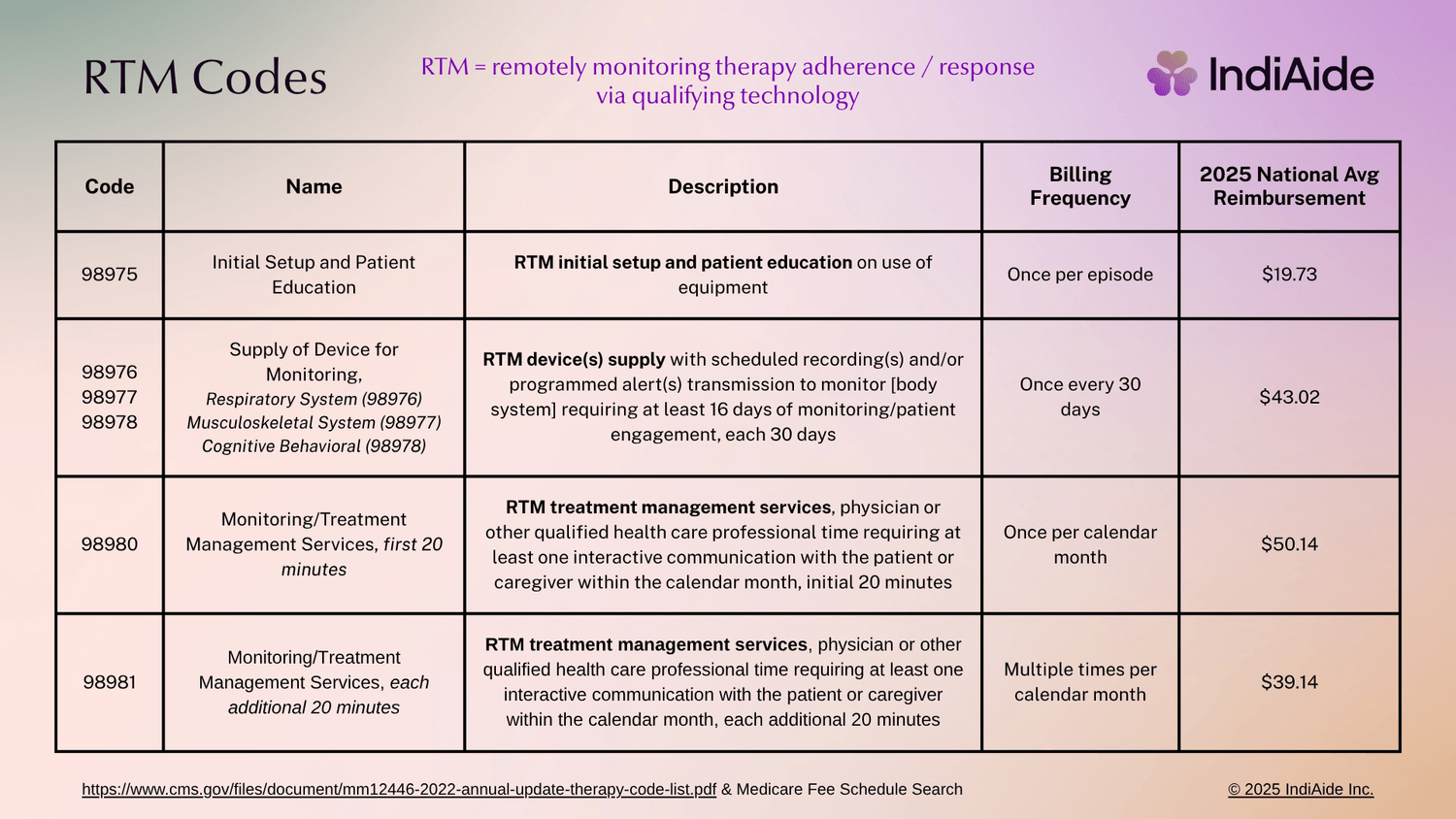
What's New: The 2026 RTM Code Expansion
The CMS CY 2026 Final Rule (Document ID 2025-19787) updates descriptors for codes 98976-78, clarifies "interactive communication" requirements, and introduces four new CPT codes for shorter monitoring periods and reduced time thresholds.
New Device Supply Code Descriptor:
Remote therapeutic monitoring; device supply for data access or data transmissions to support monitoring of [body system], [number] days in a 30-day period
New Device Supply Codes (2-15 days of data transmission per 30 days):
98984 – Respiratory system monitoring
98985 – Musculoskeletal system monitoring
98986 – Cognitive behavioral therapy monitoring
The existing device supply codes for 16-30 days (98976, 98977, 98978) remain available
New Treatment Management Code:
98979 – Treatment management services, first 10 minutes (requires at least one live, interactive communication with patient or caregiver)
The existing 20-minute treatment management code (98980) and each additional 20 minutes code (98981) remain available
Clarification on "Interactive Communication" for Codes 98979, 98980, and 98981:
In the final rule, CMS confirmed that interactive communication for RTM (codes 98979, 98980, 98981) must be live and real-time.
The rule explicitly mentions “in-clinic discussions,” confirming that in-person interactions count toward the required interactive communication, provided:
They involve real-time verbal exchange with the patient or caregiver, and
The minutes accrued are not already accounted for within the time requirements of another billable service (e.g., a therapy session)
CMS did not restrict the mode of this live communication: in-person, phone, or video are all valid so long as they meet CPT’s definition of “live, interactive communication.”
Asynchronous methods such as secure messaging, automated prompts, or app logs do not qualify.
How to Use These Codes
For Device Supply Codes:
Bill either a 2-15 day code (98984, 98985, 98986) or a 16-30 day code (98976, 98977, 98978) per 30-day period.
Choose based on actual days your patient transmitted data
💡IndiAide automatically tracks patient engagement days and calculates for each billing period. No manual counting required.
For Treatment Management:
Bill either the 10-minute code (98979) or the 20-minute code (98980) per calendar month
Choose based on your actual time spent that month - you must hit the minimum number of minutes (10 or 20, respectively) to bill either code
If you spend even more time in treatment management, you can add code 98981 for each additional 20 minutes
💡IndiAide's built-in time-tracking features log your time spent so you don't have to track your time manually throughout the month.
Why This Matters for Your Practice
Lower Barrier to Entry
The previous minimums created a catch-22: you needed higher amounts of patient engagement and clinician time spent before you could prove RTM would work in your setting.
The new codes let you:
Test workflows to find what works for your patients and team
Build patient and clinician confidence gradually
Demonstrate value almost instantly
What Happens Next: State Medicaid Updates
Now that the federal rule is finalized, individual state Medicaid programs will release their 2026 fee schedules in the coming weeks. Each state decides independently whether to adopt new codes and at what rates.
Current landscape:
16 states currently recognize RTM codes in their Medicaid programs
Many major commercial payers (Aetna, Anthem, BCBS, UnitedHealthcare) cover RTM
Coverage policies and rates vary by state and payer
💡IndiAide is Keeping Watch. We'll be monitoring state-by-state adoption of the new 2026 codes and sharing updates as they're announced. This includes coverage policies, reimbursement rates, and any state-specific documentation requirements.
Getting Started: Implementation Considerations
If you've been considering RTM, or hesitated because of the higher minimum requirements, 2026 presents an ideal opportunity to start.
Choose the Right Platform
Look for an RTM platform that:
Automatically tracks days of patient engagement and data transmission
Clearly shows you what is billable each month
Provides patient-facing tools that encourage adherence
💡IndiAide was built specifically for speech-language pathologists. We handle all of these requirements automatically. Our platform tracks patient engagement, documents your treatment management time, and generates review reports—so you can focus on clinical care while we handle the tracking complexities.
The Bottom Line
These code changes represent CMS recognition that remote therapeutic monitoring serves a legitimate clinical need and deserves appropriate reimbursement flexibility. For speech-language pathologists, RTM addresses core challenges around adherence monitoring, home program tracking, and access to care.
The 2026 expansion removes previous barriers and makes these benefits accessible to more practices and patients. Whether you're monitoring swallowing safety between dysphagia therapy sessions, tracking voice therapy exercise completion, or supporting carryover of cognitive-communication strategies, you now have the billing infrastructure to support this care model.
Questions About RTM Implementation?
The regulatory landscape just shifted in favor of speech-language pathologists ready to embrace remote monitoring. IndiAide provides the RTM platform technology and clinical support to make implementation seamless while ensuring appropriate tracking for 2026 billing requirements.
Get in Touch with Us:
Contact our team to discuss how these code changes apply to your practice
Schedule a meeting to see how IndiAide handles the new billing flexibility
Come chat with us at Booth #3341 at the ASHA Convention (November 20-22)
Official Resources:
The information shared here about Remote Therapeutic Monitoring, related CPT codes, coverage, and use cases is publicly available and included here for informational purposes only and does not constitute legal nor billing advice. Individual providers are ultimately responsible for ensuring compliance with billing guidelines. Any billing decisions made based on the information provided in this article are made at their own risk.

IndiAide helps providers turn therapy adherence into more revenue for their practice & better outcomes for their patients.
© 2024 IndiAide Inc.